
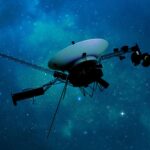








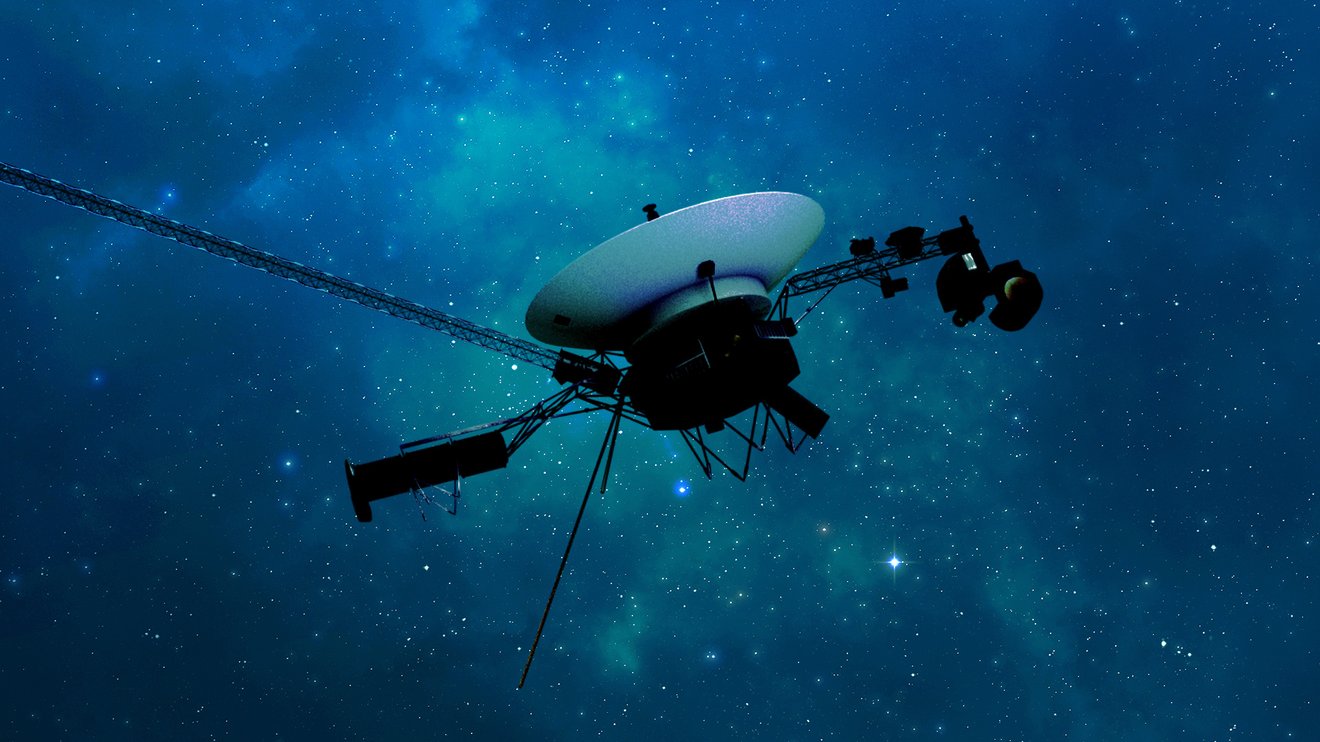

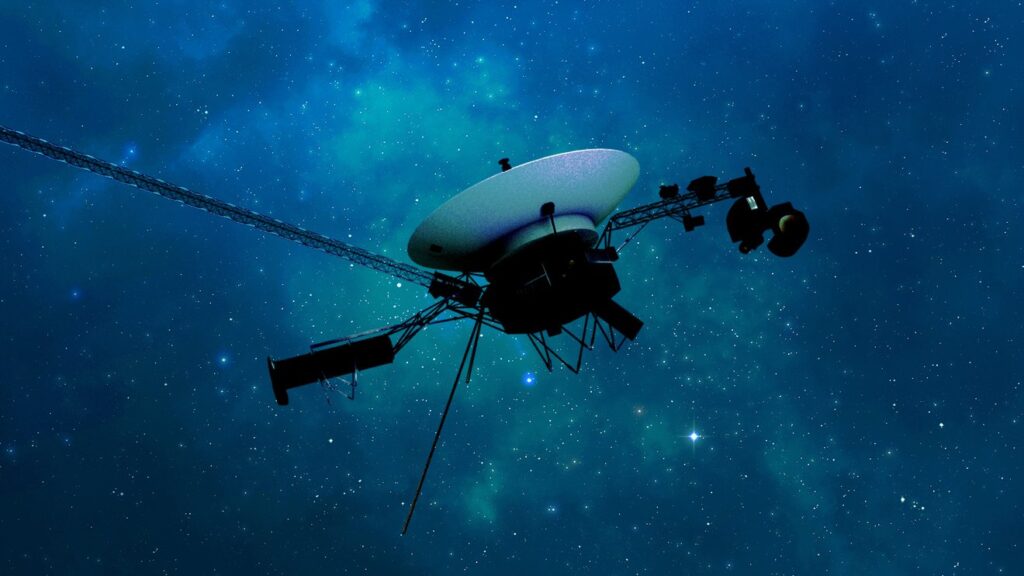
Voyager 1 said one morning, “Can you hear us?” The spacecraft’s antenna is pointed towards Earth, its transmitter is working, and it responds as soon as it receives our message. Unfortunately, the answer will arrive two days later. On November 18, 2026, a human-made spacecraft reached a distance of one light-day from Earth for the first time in history. Voyager 1 is currently approximately 25.9 billion kilometers away from us. Even light, traveling at about 300,000 kilometers per second, would only cover this distance in 24 hours. The most beautiful detail of the journey for me is this: At that distance, on the body of a spacecraft, there is a phrase written in multiple languages: “Good Morning”
The Strange Spot Next to Jupiter
Voyager 1 launched from Florida on September 5, 1977, the engineers had two very concrete goals. The spacecraft would first pass near Jupiter, then Saturn, and photograph these planets and their moons. What happened to an image it took near Jupiter in March 1979 shows how difficult it is to calculate the value of a space mission while it’s still on the launch pad.
Examining the image , expert Linda Morabito noticed a faint, umbrella-shaped protrusion extending from the edge of Jupiter’s moon Io . Was there another celestial body in the background? As she worked on the image, the scene became clearer. A volcano was erupting, spewing material hundreds of kilometers into the air above Io’s surface. For the first time, humanity had seen a volcano active outside of Earth. Moreover, the image that led to the discovery had been taken to help determine the position of the spacecraft in space. An engineer’s second look at the oddity at the edge of the photograph added a new page to astronomy textbooks.
Years later, Voyager’s camera turned towards us. In the famous Pale Blue Dot photograph, taken in 1990 from approximately six billion kilometers away, Earth couldn’t even fill a single pixel. Forget Istanbul, the Himalayas, or the Pacific Ocean; you had to know exactly where to look in the photo to make out our planet itself. Today, Voyager 1 is more than four times farther away than it was when it took that photograph.
What lies beyond a Light Day Distance?
So, can Voyager 1 now be considered to have approached a star? The closest star to the Sun is Proxima. Centauri is approximately 4.24 light-years away. Let’s express this using Voyager’s new measurement. It takes light about 1550 days to reach that star. Our spacecraft, however, traveled for 49 years to cover the distance light travels in a single day. So there are still tens of thousands of years to go, and Voyager is already on track.
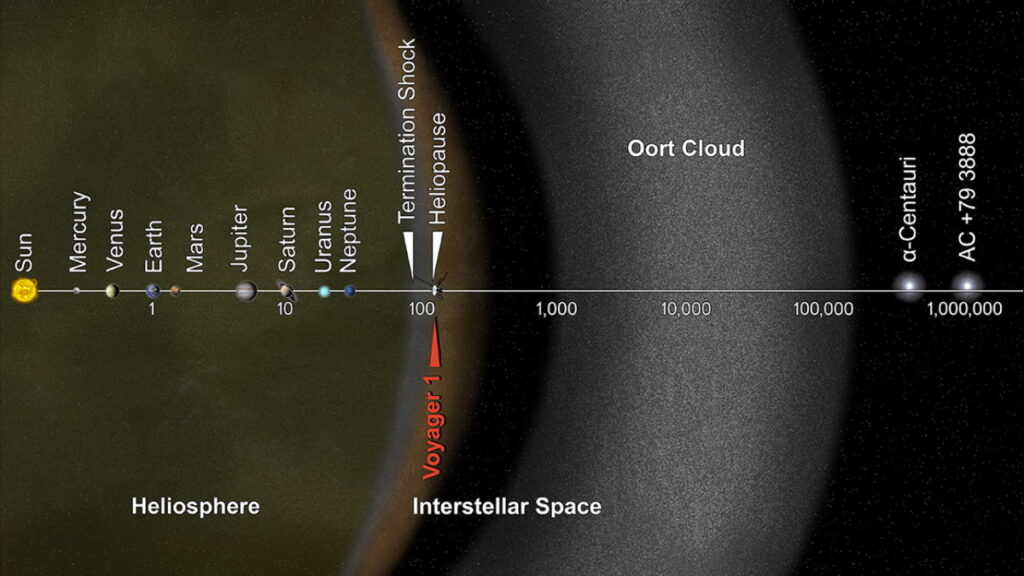 Voyager 1 had already crossed the boundary of the solar wind-dominated zone and entered the interstellar medium back in 2012. Therefore, there is no new boundary drawn in space where it passed in November. However, the latest data we have obtained show us that Interstellar Space is quite empty, but also full of hydrogen atoms.
Human Voices Recorded on Voyager 1
Now, let’s talk about that greeting. Voyager carries a gold-plated plaque, prepared with the possibility of one day encountering another civilization in mind. The plaque contains recordings of wave sounds, baby cries, musical pieces, and greetings in 55 languages. There’s a profoundly human subtlety in a human voice saying, ” Good morning .” We don’t know who will hear the message, where, or in what era. We don’t even know if it’s morning yet. Nevertheless, we’ve begun the conversation as if knocking on our neighbor’s door in Anatolia.
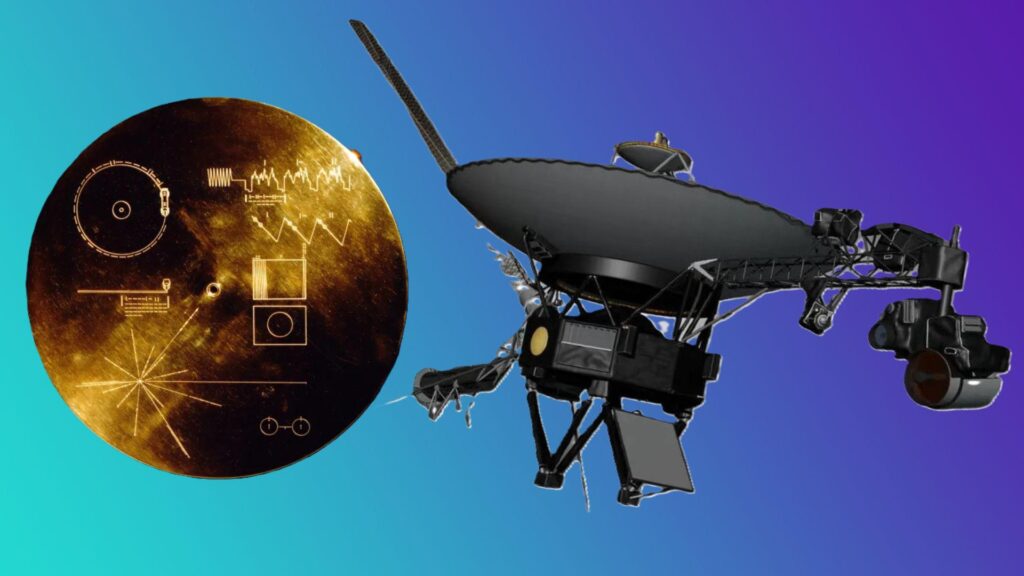 Moreover, when Voyager’s power completely runs out, the plaque will remain on the body. Even though radio communication with Earth will have long been cut off, the message will continue its journey. So, when do you think this plaque, bearing a greeting, will pass near one of the stars on its path? According to NASA’s calculations, the calendar will show the year 40272. Voyager 1 will pass approximately 1.7 light-years from a star in the constellation Ursa Minor. If we could have sent a signal from Voyager to that star that day, the journey would have taken about a year and eight months. One can’t help but think of that record. Who knows how languages will change over time? But if the record remains intact, a phrase like “Good morning” spoken in 1977 will continue its journey forty thousand years later in the same form it was spoken on that day.












Add Comment