





Quantum Entanglement is the Door to the Universe
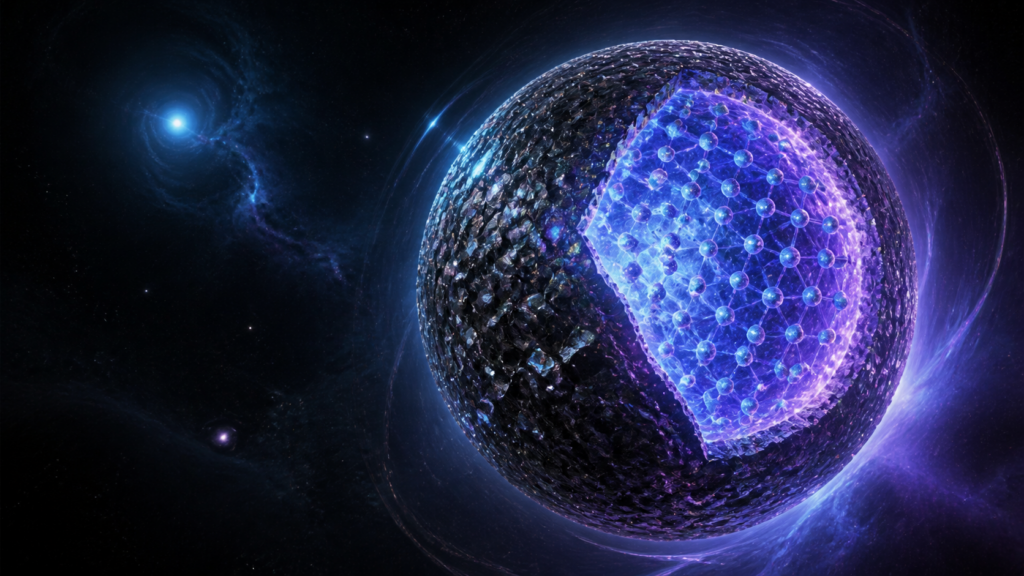
One of the most distinctive—and truly mind-boggling—branches of science to explain our universe is quantum mechanics. As I have noted in previous articles, observation is fundamental in quantum mechanics; indeed, a form of reality comes into existence only when an observation occurs under conditions consistent with quantum mechanics. However, an intriguing finding here is that when you observe a system, you inevitably interact with it—meaning the system has, in fact, already changed. Within this profound scientific discipline, a multitude of fascinating phenomena and insights emerge. In this context, there are moments in science that do not merely leave a fragment of information in the human mind; rather, they unlock a door that compels us to question the very nature of existence itself. Quantum entanglement is precisely such a door. Although it may appear at first glance to be an abstract—perhaps even somewhat remote—concept, it is, in reality, one of the universe’s deepest mysteries—one that scientists have been grappling with since the beginning of the 20th century. Things we once believed to be separate may, perhaps, never have been separated at all.
Spooky Action at a Distance
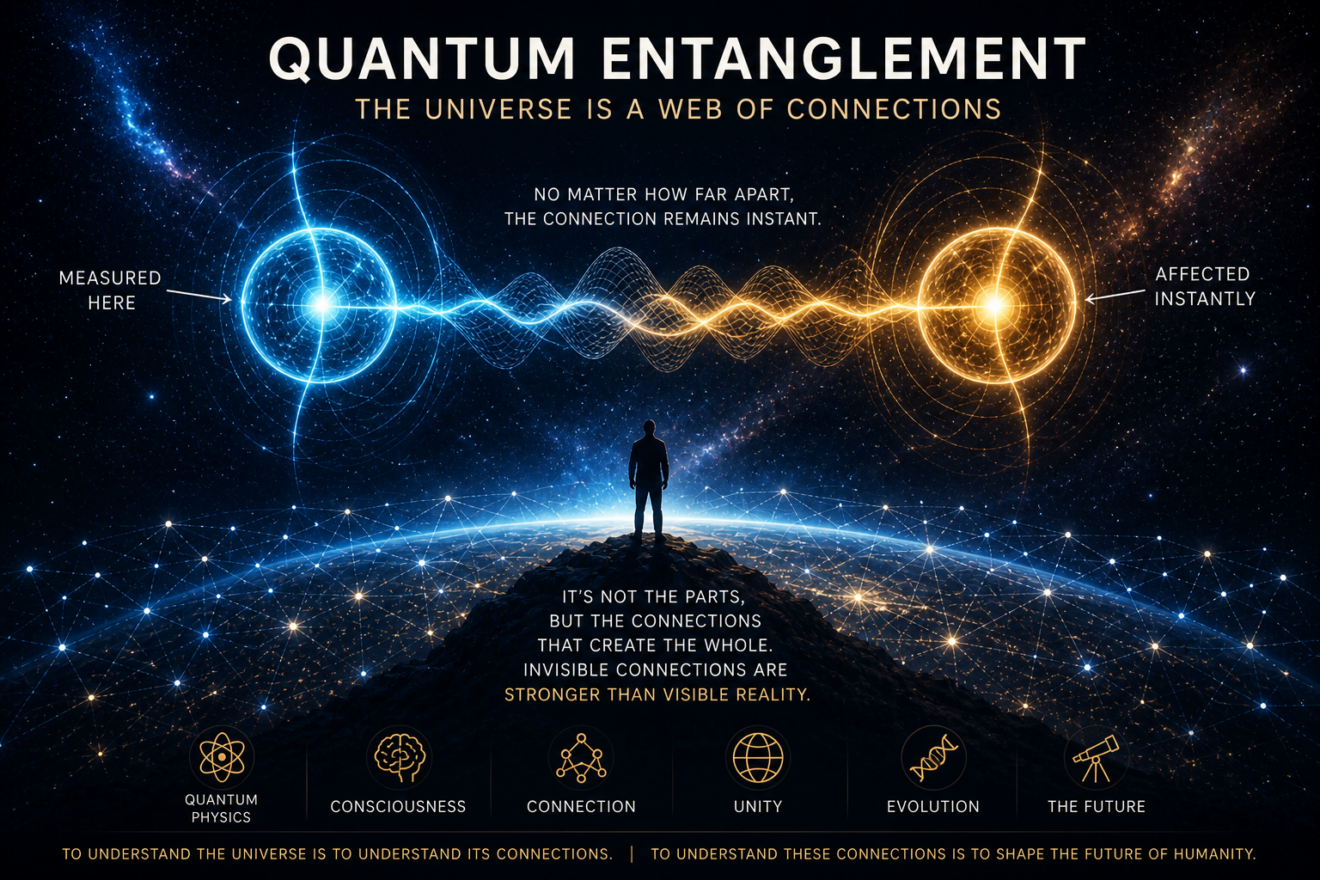
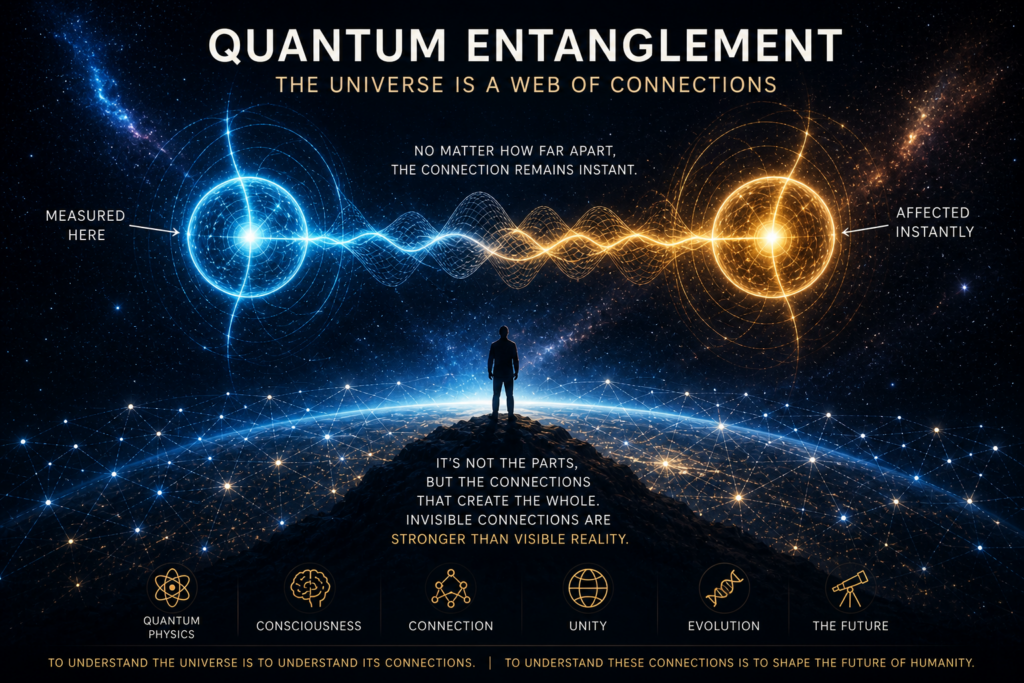
When this concept was first discussed within a thought experiment proposed by Albert Einstein and his colleagues, Einstein dubbed it “spooky action at a distance.” This is because the bond established between two entangled particles transcends the boundaries of classical physics. Whether separated by a mere meter or by intergalactic distances, the moment the state of one particle is measured, the other responds instantly and correspondingly. There is neither a signal nor a delay. Behaving as if no distance existed between them, these particles remain interconnected—independent of both space and time—within a kind of eternity.
Now, we must pause here and ask ourselves this question: If information cannot be transmitted faster than the speed of light, how does this interaction take place? This is precisely where the “Wow!” moment begins. Modern experiments—particularly those based on Bell’s Theorem—have revealed that this effect is, in fact, a fundamental feature of nature. The awarding of the 2022 Nobel Prize in Physics to experimental work in this field has conclusively demonstrated that entanglement is no longer merely a theoretical curiosity. However, there is a lesser-known—and far more striking—fact: Entanglement may not exist solely between particles, but rather between information itself.
Is Information the Universe’s Fundamental Building Block?
According to certain theories, the fundamental building block of the universe is not matter, but information. This perspective was notably articulated by John Archibald Wheeler in his “It From Bit” concept. In other words, physical reality may emerge from an information-based structure. If this holds true, then entanglement is not the linking of two particles, but rather the linking of two states of information. And this connection may take place on a plane situated beyond space-time.
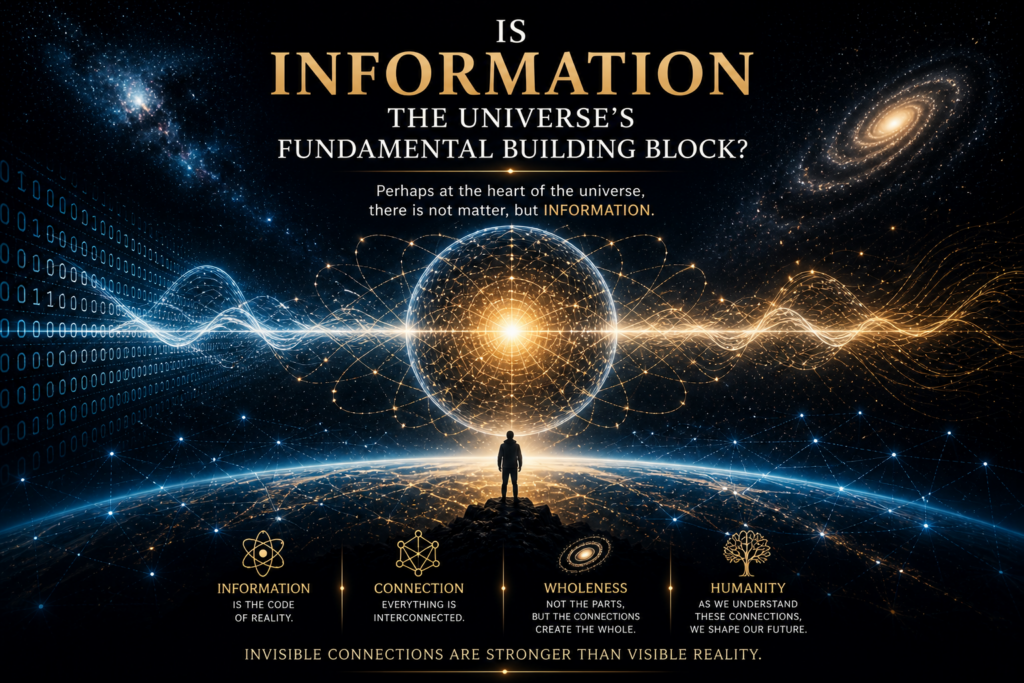
If this theory proves correct, then everything existing in the universe—even mass and energy—could simply be different facets of a single unit of information. In this scenario—where the smallest unit of information is termed a “qubit“—nothing is ever truly lost; things merely change form or undergo phase transitions, yet fundamentally continue to exist as particles of information—that is, as qubits. Under this framework, perhaps even death could be interpreted as the transformation of matter back into information—a process through which your existence, in a sense, might persist within the universe as information particles even after death. Of course, one crucial caveat must be kept in mind: This remains strictly a theory and has by no means been conclusively proven. Nevertheless, an increasing number of scientists are focusing their attention on this concept—though, personally, I remain unconvinced.
Is the Universe Real, or Is It a Hologram?
At this juncture, an even more astonishing idea comes into play: Could the universe actually be a “hologram”?
Known as the Holographic Principle, this approach suggests that the three-dimensional reality of the universe may, in fact, be encoded onto a two-dimensional surface of information. If this is the case, quantum entanglement may be telling us this: We are not merely actors in a three-dimensional scene, but rather projections of a much deeper reality. Interestingly, several prominent physicists are currently focusing their attention on this concept. Personally—as a scientist—I do not subscribe to this theory; nevertheless, there are indeed several studies exploring it. In fact, a similar concept was previously put forward as a theory known as the “Boltzmann Brain.” According to this theory, rather than the universe existing with its complex laws, a single brain—formed through quantum entanglement—might be imagining everything in the form of a hologram, implying that the universe does not actually exist. Everything would, therefore, exist solely within the mind of this solitary brain. I, likewise, completely disagree with this theory—as do a great many other scientists.
Quantum Entanglement Also Prevails in Nature
Here is an even more striking piece of information: Entanglement may not be limited to the delicate systems engineered in laboratories; it may also emerge spontaneously in nature. Some studies suggest that photosynthetic plants utilize quantum entanglement to enhance their energy efficiency. In other words, nature may have been harnessing the principles of quantum physics for billions of years—long before we ever became aware of it.
This naturally prompts the question: If nature is capable of doing this, why shouldn’t we be able to do the same?
Today, thanks to entanglement, quantum computers are advancing toward a level of computational power that lies far beyond the reach of classical computers. Quantum communication systems, meanwhile, offer encryption methods that are—at least in theory—impossible to crack. The satellite-based quantum communication experiments conducted by China have demonstrated that entanglement can be preserved over distances spanning thousands of kilometers.
Entanglement and Consciousness: Do We Truly Exist Because of It?
But perhaps the least discussed—and most startling—possibility is this: Could entanglement be linked to consciousness? This remains a speculative realm; however, some researchers argue that the brain incorporates quantum processes and that the phenomenon we call consciousness may be rooted in entanglement. If this proves true, the human mind may not merely be a biological structure, but rather a node connected to the universe’s quantum web.
At this juncture, we must pause and ask ourselves once again: Are we truly alone, or are we merely nodes within an invisible bond?
Quantum entanglement reveals to us more than just a physical phenomenon; it also demonstrates just how limited our perception of the universe truly is. The world of classical thought—founded upon the concept of separation—gives way, at the quantum level, to the concept of connection.
Perhaps our greatest misconception is believing ourselves to be separate from the universe.
Reshaped Physics and a Wholeness Forged from Connection
Yet, entanglement tells us this: The universe is not merely the sum of its parts, but a totality of connections. And here, the issue is not merely one of scientific curiosity, but also an existential inquiry. For if everything is interconnected, then every step we take—every thought we conceive—may possess a sphere of influence far broader than we imagine.
Finally, I would like to conclude with this question:
If even the smallest particles of the universe cannot be severed from one another, why do we, as humanity, still cling to the illusion of separation? Perhaps this is the greatest lesson of quantum entanglement: Invisible bonds are stronger than visible reality.
And the day we begin to comprehend these bonds, we will start to rewrite not only the laws of physics but also the future of humanity. As a nation, we, too, must rapidly establish a stronger presence in these “cutting-edge” fields of science and decipher the secrets of the universe for the sake of humanity’s future.
Summary of Quantum Entanglement
What is quantum entanglement, and why is it so profound?
Quantum entanglement is a phenomenon where two particles become interconnected in a way that the state of one instantly influences the state of the other, regardless of the distance between them, revealing deep mysteries about the universe and the nature of reality.
Why did Einstein call entanglement ‘spooky action at a distance’?
Einstein referred to entanglement as ‘spooky action at a distance’ because the instant correlation between entangled particles defies classical physics, as it appears to occur faster than the speed of light without any signal passing between them.
Is the universe fundamentally made of matter or information?
Some theories suggest that the universe is built from information, proposing that physical reality emerges from an information-based structure, where everything could be a manifestation of interconnected information states.
Could our universe actually be a hologram?
The Holographic Principle proposes that the universe’s three-dimensional reality might be encoded on a two-dimensional surface of information, implying that what we perceive as reality could be a projection from this deeper, underlying information layer.
Does quantum entanglement occur naturally in nature, and how does it impact technology?
Yes, quantum entanglement can spontaneously occur in nature, as seen in photosynthesis, and it is harnessed in technologies like quantum computers and secure quantum communication systems, which operate over vast distances.







Add Comment