










Since the dawn of civilization, humanity has spent millennia looking to the skies in search of the unknown. Starting with the Sumerians, early civilizations created calendars by observing the stars, sailors navigated by the heavens, and philosophers sought the secrets of the universe in the skies. Today, we turn our telescopes toward distant galaxies, search for signs of life on Mars, and plan for the establishment of permanent bases on the Moon. Yet, perhaps one of the greatest unknowns lies not above our heads, but some 3,000 kilometers beneath our feet.
Earth’s Core as an Electric Generator
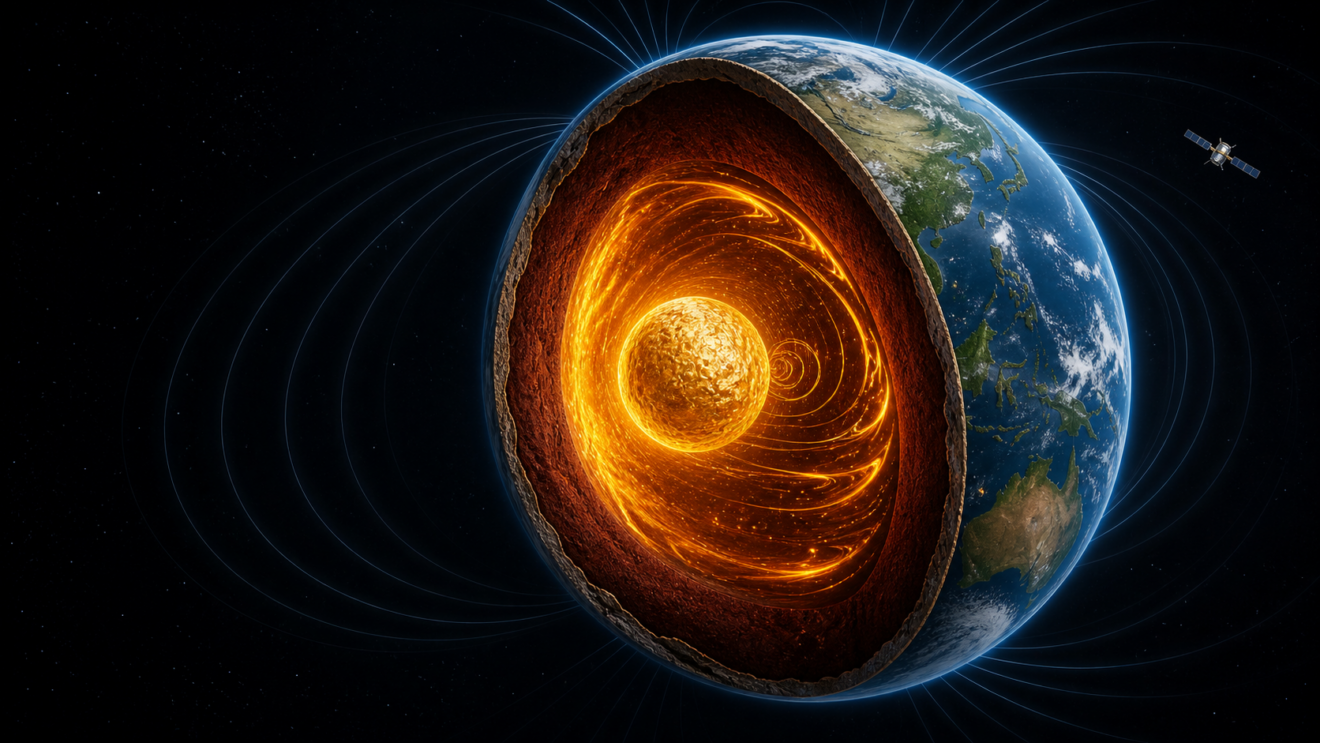
Viewed from the outside, Earth appears to be a calm, solid, and unchanging planet. However, beneath the thin crust we inhabit—at the very heart of our planet—a colossal machine is at work. At the center of this machine lies a solid inner core composed primarily of iron and nickel, surrounded by an outer core of constantly moving liquid metal. It is the motion of this liquid metal that functions like a natural electric generator, creating Earth’s magnetic field.Without this invisible generator, Earth might not be the planet it is today.
This is because our planet’s magnetic field forms a massive shield that deflects a significant portion of the electrically charged particles and cosmic radiation constantly streaming from the Sun. One reason Mars is now a cold, dry planet with a thin atmosphere is that it largely lost its global magnetic field. Earth’s magnetic shield does more than just ensure compasses point north; it protects our atmosphere, satellites, and communication systems—and, by extension, our technological civilization.
However, recent research reveals that this giant generator does not operate as steadily as we once thought. A new study conducted by the University of Edinburgh and the British Geological Survey, based on data from the European Space Agency, has detected a highly surprising change in Earth’s liquid outer core. According to the research, a vast flow of liquid metal beneath the Pacific Ocean changed direction around 2010. The iron-rich flow, which had previously been moving weakly westward, suddenly began to shift strongly toward the east. Scientists are astonished that this change occurred within a geologically brief time frame of just a few years.
This is because we typically assume that events deep within the Earth unfold over timescales of thousands or even millions of years. Yet, a river of liquid metal—located approximately 2,900 kilometers down and impossible for us to see directly—changed direction within a span short enough to be measured against a human lifespan.
Beneath the Pacific Ocean, across a region larger than the continents, a current of liquid iron—heated to thousands of degrees—quietly altered its course. The billions of people living on Earth felt nothing; the seas did not surge, earthquakes did not strike, and the color of the sky did not change. However, satellites in space revealed this movement at the planet’s heart by measuring minute fluctuations in Earth’s magnetic field. Researchers utilized satellite and ground-based observation data collected between 1997 and 2025, analyzing measurements obtained from various European Space Agency missions. Sensitive magnetometers aboard the Swarm satellites are capable of distinguishing magnetic signals originating from the core from those arising from the Earth’s crust, oceans, ionosphere, and the space environment. Thus, for the first time, humanity has begun to monitor movements deep within our planet from space. Moreover, this change in the outer core is not an isolated phenomenon. Other studies conducted in recent years have shown that the rotation speed of the solid inner core relative to Earth’s surface has also slowed down since approximately 2010. Meanwhile, a study published in 2025 presented findings suggesting that physical shape changes might be occurring at the boundary of the inner core. Scientists hypothesize that there could be a link between movements within the inner core and a shift in the direction of the outer core flow beneath the Pacific. However, it is important to note that this is not yet a confirmed explanation, but rather a scientific possibility that requires further investigation.
Will Earth’s Magnetic Field Disappear?
Current data do not point to any imminent catastrophe awaiting humanity. Researchers also clearly state that this change poses no direct danger to humans or the climate. The fact that the eastward-moving current beneath the Pacific began to weaken again after 2020 suggests this could be a temporary fluctuation, a regular oscillation, or a new, long-term equilibrium. We do not yet know which is the case.
Even minor changes in Earth’s magnetic field can affect a wide range of systems—from aircraft and ship navigation and satellite positioning to military platforms and spacecraft control. Today, many navigation and orientation systems rely on the World Magnetic Model, which is updated regularly. Because the magnetic field is not static, even runway numbers sometimes have to be changed over time. Ships and many logistics operations depend on the magnetic field remaining stable and reliable.
The great powers of the future will not simply be the nations that launch the most satellites or build the most powerful rockets. They will also be the countries capable of measuring Earth’s magnetic field with the greatest precision, modeling changes in the core, and accurately forecasting space weather.















Add Comment