




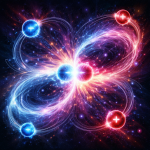


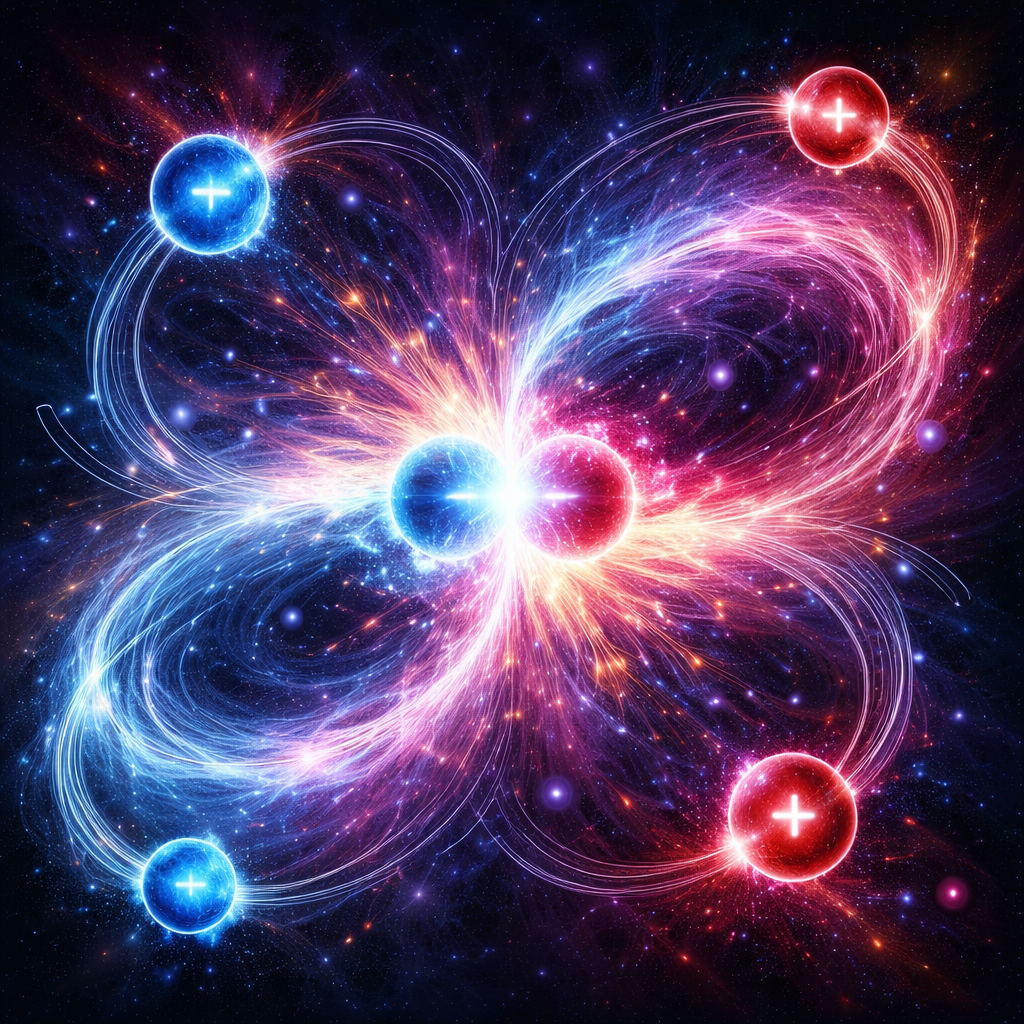

Although antimatter sounds like something out of a science fiction movie, it is actually one of the most real, clearly observed, and experimentally produced phenomena in nature. In its simplest form, antimatter is the anti-twin of matter: the positron, the antimatter counterpart of the electron, has a positive charge instead of a negative one; the antiproton, the antimatter counterpart of the proton, is negatively charged; and the antineutron, the antimatter counterpart of the neutron.
Who Found Antimatter?
First theoretically predicted by Paul Dirac, antimatter became an experimental reality in 1932 with Carl Anderson’s discovery of the positron in cosmic rays. Today, we routinely produce antimatter particles in particle accelerators, and positrons are used in PET scanners for medical imaging. In short, antimatter is not fiction but a real phenomenon of nature with applications even today. The question, “Are there stars and galaxies made of antimatter?“, is just as intriguing as antimatter itself. According to the Big Bang theory, the universe was initially at an incredible temperature and density, and matter and antimatter should have been produced in almost equal amounts. However, our observations show that the entire universe is largely composed of matter.
Are There Antimatter Galaxies Out There?
If we were to find antimatter galaxies, stars, or antimatter clouds, they would create high-energy gamma-ray bursts when they came into contact with matter. To date, we have not encountered such signs in space. Therefore, we can say that the large-scale structure of the universe is not symmetrical with respect to antimatter. The reason for this “asymmetry,” that is, why antimatter disappeared in the early universe while matter remained, is one of the greatest cosmological mysteries that physicists are still trying to solve. If we can lift this veil of secrecy, we can understand both the Big Bang and the evolution of the universe much more deeply. However, antimatter is not entirely lost. Antimatter particles can be formed in some corners of the universe. For example, positrons and antiprotons are produced near black holes, at the magnetic poles of neutron stars, or during cosmic ray collisions. We can measure antimatter particles in cosmic rays that reach Earth. However, these are transient and rare processes. We have no evidence that the amount of antimatter needed for massive structures like antimatter stars or antimatter galaxies exists.
What are the Uses of Antimatter?
The importance of antimatter in the universe is not limited to understanding this deficiency. Antimatter-matter annihilation is the most efficient energy conversion, transforming all mass into pure energy: according to Einstein’s famous E=mc² formula, you can produce petawatt-level power per gram. In theory, one gram of antimatter could create an explosion many times larger than the Hiroshima bomb. Therefore, antimatter is potentially both a weapon and an energy source. However, there are enormous practical obstacles. First, antimatter production is extremely costly and inefficient. The world’s largest particle accelerators produce antimatter in amounts smaller than micrograms per second, and magnetic traps are needed to store it because antimatter instantly annihilates upon contact with any matter. With our current technology, it is impossible to produce antimatter in quantities usable for military purposes. However, the defense industry is conducting theoretical studies on this: the idea of micro-nuclear explosions that could be initiated with antimatter particles has long interested the US Air Force and DARPA. The concept of an antimatter bomb is a more sensational scenario: theoretically, a bomb of tens of kilotons could be made from one gram of antimatter. However, its production, storage, and delivery are almost impossible. Nevertheless, antimatter can be used as a “trigger”: initiating a fission or fusion reaction with antimatter particles gives rise to the idea of developing smaller, “cleaner” nuclear weapons. Therefore, antimatter is not entirely irrelevant militarily, but the fear of an “antimatter bomb” in the near future is not realistic, although research continues. Weapons aside, antimatter has peaceful applications in our lives even today. In medicine, PET (Positron Emission Tomography) scans are one of the gold standard imaging methods for detecting tumors by capturing the gamma rays produced by positrons. In physics, collisions with antimatter particles have revolutionized our understanding of fundamental forces.
Can Antimatter be Used for Space Travel?
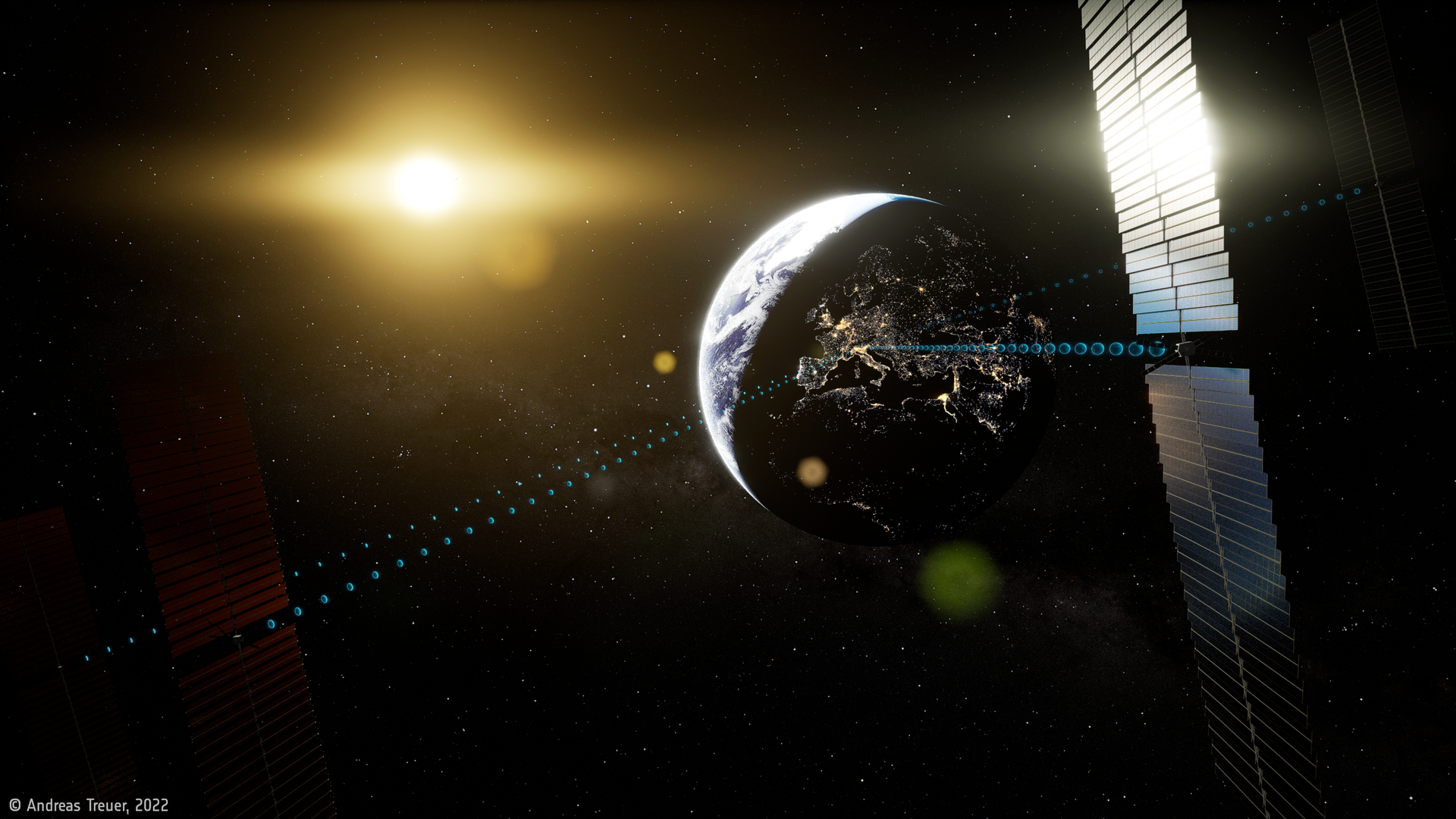
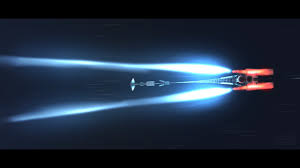 Looking to the future, antimatter fuels dreams of space travel. Antimatter-fueled engines, particularly fusion engines heated by antimatter fuel or photon rockets utilizing direct annihilation reactions, could theoretically make travel near the speed of light possible. These concepts have been seriously investigated by NASA andESA. The problem remains: producing and storing antimatter is extremely expensive. However, if the cost of antimatter production decreases in the future, for example, if it becomes possible to obtain this fuel in space using solar energy or by collecting antimatter from cosmic rays in Jupiter’s magnetosphere, then antimatter-powered ships could be one of the most realistic options for interstellar exploration.
Can Antimatter Particles Go Back in Time?
Antimatter particles can be mathematically defined as normal particles moving backward in time. This peculiarity is related to the time symmetry of quantum field theory, and some believe it signifies a passage to a different dimension or universe. Physically, antimatter particles share the same spacetime as our world but move with opposite charges and quantum numbers. Some science fiction writers depict antimatter as a gateway to parallel universes, but so far, no physical theory or experimental observation supports this. On the other hand, antimatter is crucial in cosmology for testing different models of the universe due to the breaking of matter-antimatter symmetry (CP violation). If there were excesses of antimatter in different regions of the universe, perhaps the cosmic structure could have a completely different order. Therefore, antimatter is key to the big questions of why the universe is the way it is. Physicists are trying to measure these tiny differences between antimatter and matter with millimeter precision using detectors like the LHCb experiment. In conclusion, antimatter is both extremely real and extremely mysterious. Yes, it exists. Yes, we can produce it. Yes, we use it in medicine and basic science. Yes, in theory, it could be a terrifying weapon or an amazing space engine. But we don’t yet have the necessary technology and infrastructure for that. Antimatter galaxies or stars have not yet been observed; at least to date, we have found no evidence that the universe is symmetrical with respect to antimatter. Yet, understanding antimatter is one of the most powerful keys we have to solving why we live in a universe filled only with matter, how Big Bang worked, and what makes the fundamental laws of physics possible, and what makes them impossible. Scientists may learn to use antimatter as a weapon or an energy source, but what is truly valuable is using it as a tool to ask questions, to understand nature, and to push our imagination beyond its limits. As humanity’s knowledge of antimatter progresses, perhaps one day we will travel at near-light speeds with antimatter and reach the stars. Or at least, we will better understand why the universe is the way it is. And even that in itself would be a revolution. Perhaps understanding the reverse side of the universe will help us to better understand the visible side of the universe.







Add Comment