








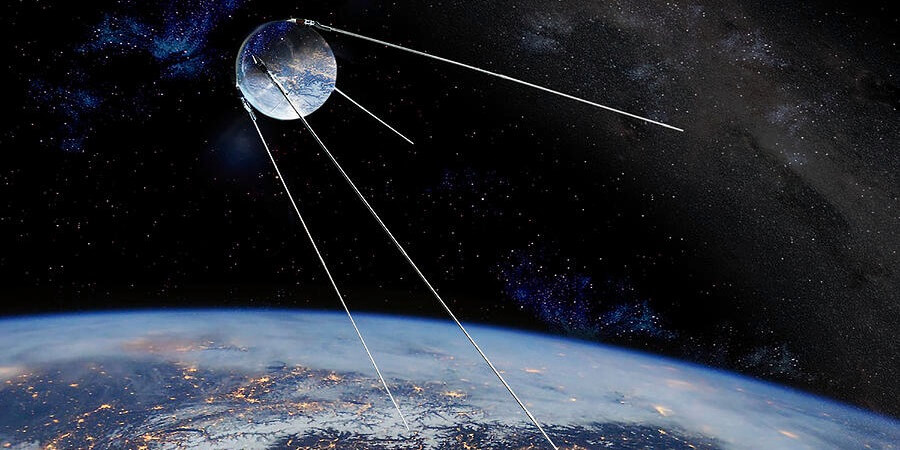

In space history, without a doubt, the most important date is the launch of the Soviet satellite Sputnik to space on October 4, 1957 at 7:28 PM. The launch of the first man-made object to space represents the beginning of the space age, when humanity started to conquer outer space. The Sputnik Satellite was 83.6 kilograms and its main function at a low earth orbit was to beep radio signals at a regular interval. The launch of Sputnik also led to the start of the Space Race between the Americans and the Soviets.
 Sputnik orbited for three weeks before its batteries died and then orbited silently for two months before it fell back into the atmosphere on 4 January 1958. Its radio signal was easily detectable by radio amateurs and the 65° orbital inclination and duration of its orbit made its flight path cover virtually the entire inhabited Earth.
The satellite had a one-watt, 3.5 kg (7.7 lb) radio transmitting unit inside, developed by Vyacheslav I. Lappo from NII-885, the Moscow Electronics Research Institute that worked on two frequencies, 20.005 and 40.002 MHz. Signals on the first frequency were transmitted in 0.3 s pulses (near f = 3 Hz) (under normal temperature and pressure conditions on board), with pauses of the same duration filled by pulses on the second frequency Analysis of the radio signals was used to gather information about the electron density of the ionosphere. Temperature and pressure were encoded in the duration of radio beeps.
While compared to the satellites of today, Sputnik was very basic but its launch on October 4, 1957, changed human history and its impact on the space age is still felt even today. To commemorate the launch, every year the day of October 4 and the week proceeding it is called as Space Week and celebrated across the world.
















[…] The Launch of Sputnik and The Dawn of the Space Age – Aerospace Lectures […]
[…] The Launch of Sputnik and The Dawn of the Space Age – Aerospace Lectures […]